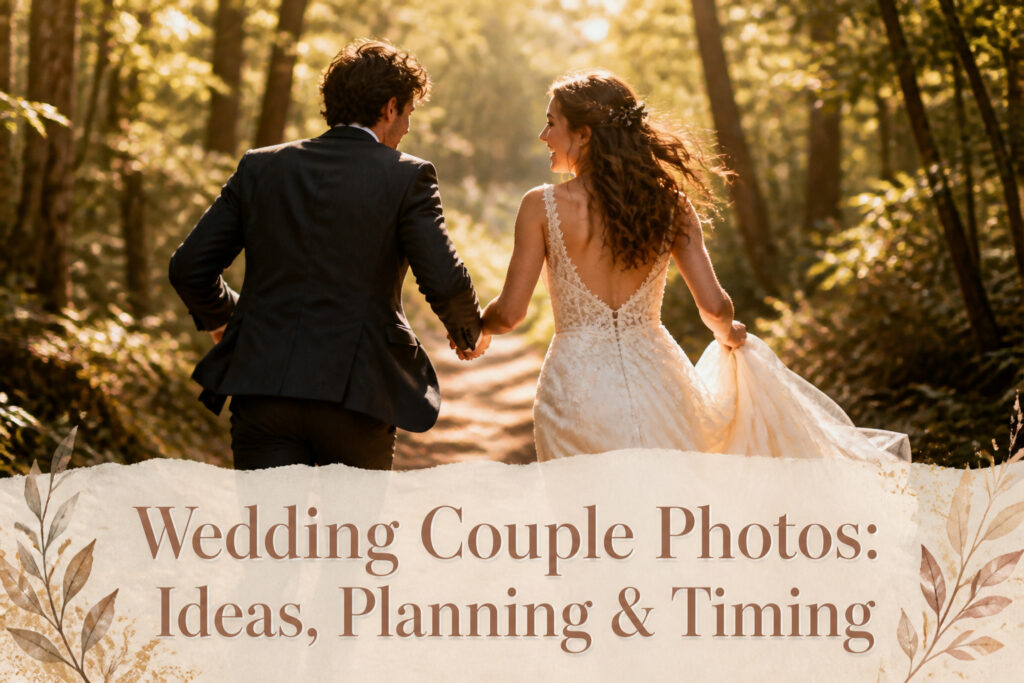
Wedding couple photos are the portraits of the two of you together, shot in windows stolen from the day’s schedule. The catch is that those windows close fast: golden hour lasts 10 to 20 minutes once speeches run long, and missing it means losing the light that flatters skin better than any filter. A photographer who scouts the venue the week before, timing walks between a stone wall near the parking lot and a service corridor with afternoon light, builds a short list of three to four locations, not ten, so you spend the day celebrating instead of walking.
Candid Moments

The best candid wedding couple photos happen when the photographer disappears into the background of your day. That means positioning matters more than most couples realize. A photographer who hangs back during speeches, stays near the edges of the dance floor, or watches from across the room during cocktail hour catches the glances and laughter you’d never stage deliberately.
Continuous shooting mode is what separates a real laugh from a frozen grimace. A single shutter click risks catching someone mid-blink or with a polite half-smile. Burst shooting gives the photographer ten or twelve frames to find the one where you both look actually happy, not performatively so.
Anticipating movement takes practice, and it is worth asking your photographer how they handle it. The walk from the ceremony to the reception, the moment right after a toast when you turn to each other, the quiet seconds while you wait for the next song to start: these are not random. A photographer who has shot enough weddings reads the rhythm of the day and positions themselves before the moment breaks.
Some couples worry that candids mean giving up all direction. The better approach is light guidance: a suggestion to hold hands the way you normally would, or to keep talking while walking, so the photo shows your actual interaction rather than a posed approximation of it. The result still looks unplanned because the emotion underneath is real.
Golden Hour Photos

The light just before sunset, usually called golden hour, does more to flatter skin than any filter you can buy later. The sun sits low and the shadows soften, so the two of you look like yourselves at ease rather than yourselves squinting.
That window is brief. In summer you might get up to 45 minutes, but 10-20 minutes is often all a couple actually receives for portraits once speeches run long or someone needs the restroom. I build timelines assuming the shorter end, and I tell couples straight: if the DJ announces cake cutting at 7:15 and sunset is 7:40, we step out between courses or we miss it entirely. Most guests never notice you’re gone for five minutes; the photos you bring back are the ones they ask about after.
A little fill-flash can balance the setting sun when it drops too low, though I prefer working with what the sky gives me if the timeline allows. The real decision is yours, made weeks ahead when the schedule gets locked. Golden hour waits for no one, and it does not rerun.
Location Variety

The best backdrops at a venue are rarely the ones guests will crowd around. A stone wall near the parking lot, a service corridor with late-afternoon light, a patch of garden behind the kitchen: these spots stay empty during cocktail hour and often carry better light than the ceremony arch everyone wants to photograph.
I walk every venue beforehand, usually the week of the wedding, timing how long it takes to move between locations and noting where guests tend to linger. That walk produces a short list of three to four spots, not ten. Each location should tell a different part of the same day. The garden behind the kitchen works for quiet, mid-morning portraits. The ruins or architectural feature, if the venue has one, often needs evening light to lose its harsh shadows, so that becomes a return trip after dinner rather than a stop during the first look.
One location per mood is enough. More than that, and the couple spends the day walking instead of celebrating. If the venue has a second site nearby, like museum gardens after a register office ceremony, that counts as a bonus location, but only when the travel time is under five minutes each way. Otherwise the logistics eat the joy.
Light matters more than scenery. A plain wall with golden sidelight wins against a famous view with overhead noon sun every time. The scout walk is where you test that, not on the wedding day.
Natural Poses

The stiff wedding portraits your parents have in their hallway came from staring at the camera and waiting for the click. I stopped asking for that years ago, and the change in my couples is immediate. The moment they look at each other instead of the lens, their shoulders drop, their breathing shifts, and I get the photograph they actually want to keep.
Direction still matters. I give couples something to do with their hands or a short distance to walk, then stay quiet while they settle into each other. A documentary approach works here too; even in a fifteen-minute portrait window, the images that hold up are the ones that look like a stolen moment rather than a setup.
What makes these portraits yours and not a template is the particular way you two already move together. Some couples fall into whispered jokes. Others go still and forehead-to-forehead. My job is to notice which one you are and not force the other version. The camera records the difference, and you will see it when you print them.
Pre-Wedding Shoots

A pre-wedding shoot gives you a trial run at being photographed together before the pressure of the actual day. Most couples who book one tell me the same thing afterward: they stopped worrying about how to stand or where to look, and that carried straight into the wedding.
The ones who skip it often need more time to warm up on the day itself. Some relax once the portraits start moving; others stay uncomfortable and end up wanting fewer posed shots than they originally planned. The difference is usually whether they’ve already felt what it’s like to have a camera on them as a couple.
The photographer’s own ease matters here too. A relaxed photographer makes the posed portion feel less like a performance. If you’re already on edge, a stranger barking directions will not help. The pre-wedding session lets you learn whether this person’s style settles you down or winds you tighter, while there’s still time to adjust the plan.
For couples working with a tight budget, the session is an extra line item that may not fit. The trade-off is real: spend here for comfort, or keep that money for prints later. What I’ve noticed is that the couples who felt stiff at the engagement shoot and worked through it showed up to the wedding already knowing their angles. The ones who felt stiff and did nothing about it usually stayed stiff.
Weather Considerations

Rain on a wedding day can feel like a crisis until you realize it is just another texture to work with. I keep clear umbrellas in my kit for exactly this reason: they shield you from the weather without turning you into a dark blob in the frame, and the raindrops stay visible as atmosphere rather than obstruction. The couple still reads, the light still wraps around them, and the photos do not look like a compromise.
Bright sun is the harder opponent. Open shade is the first refuge, the kind cast by a building overhang or a thick tree line, where the light softens without going flat. Positioning matters too: turning the couple so the sun falls behind them, or at a sharp angle, keeps the faces from washing out and adds dimension instead of squinting. Midday sun directly overhead turns eye sockets into shadows; that is when you move.
Moving indoors does not have to mean surrendering the feel of the portraits. Window light is the substitute that still behaves like daylight, and a room with tall windows or glass doors can give you the same gentle wrap if you place the couple close enough. The background may change from garden to plaster, but the quality of light on the faces stays consistent, and that consistency is what keeps the set of portraits from feeling like two different shoots stitched together.
Candid vs. Posed Shots

Most couples tell me they want their wedding couple photos to feel natural, not stiff. The trick is that candid and posed each do a different job, and the final album needs both.
| Candid shots | Posed portraits | |
|---|---|---|
| Best for | Emotional authenticity: real laughter, the unguarded glance | The traditional look: clean composition, everyone looks their best |
| Requires from photographer | Documentary eye, anticipation, staying invisible | Light direction on where and how to stand, gentle guidance |
| Requires from couple | Comfort being yourselves while someone watches | Brief time away from guests, willingness to be directed |
| Where the album needs it | The story of the day, the feeling | The wall-worthy print, the family-requested formal shot |
I shoot about 90% of the day candid, but those posed portraits still matter. The posed ones give you a backdrop that shows off your venue, a flattering angle, and a guaranteed keeper. The candid ones catch what you actually said to each other. Skip either, and the album feels thin.
Indoor vs. Outdoor Locations

Outdoor light is free and directional, but it hands you a narrow window. That summer stretch just before sunset, maybe 45 minutes, is what photographers chase for the low, warm glow that makes skin look alive. Miss it and you are working against flat midday glare or racing the clock.
Indoor light is weaker, yet it can be shaped. A tall window to one side of a couple gives the same dimensional quality as a softbox, and the shadows fall off naturally. The trick is placing them close enough to the glass that the light wraps, far enough from the wall behind that the background goes soft and dark. Venues with tall feature windows, or a cluster of fairy lights once evening sets in, give you something outdoor locations cannot: controlled atmosphere without the weather bet.
Rain forces the move inside, and the change is bigger than most couples expect. The light drops, the color temperature shifts toward the cooler end, and the spaces that looked spacious in sunlight can turn tight with a flash setup. A photographer who plans for this will scout those window-lit corners ahead of time, not improvise after the ceremony.
| Outdoor | Indoor | |
|---|---|---|
| Best light window | ~45 min before sunset | Midday through tall windows |
| Ambiance control | Limited; depends on weather | High; fairy lights, feature windows |
| Rain backup | n/a | Window light replaces golden hour |
The window-lit indoor shot is the one most couples skip asking for, and it is often the keeper when the forecast falls apart.
Why Couple Photos Matter

The quiet moments away from the crowd are where the day actually lands. After hours of greeting relatives and timing entrances, twenty minutes with just the two of you gives the photographer room to catch how you actually look at each other, not how you pose for a camera. Those portraits become the images couples return to decades later.
Skipping them to save money is a real temptation when the whole budget sits under $10,000. I get it. But the couple portraits are what outlast the centerpieces and the playlist. One photographer I follow always sends the newlyweds off alone for a few minutes after she has what she needs; they usually agree immediately. That impulse to escape together for a breath says something about what the day actually means.
The trade-off isn’t couple photos versus no couple photos. It’s structured portrait time versus stolen minutes. An hour carved out, like one London pair insisted on, lets you walk through the city and collect settings that contrast with the formality. Even roadworks outside Madame Tussaud’s became color and movement in their gallery. Shorter windows work too, but walking shots, back views for the album’s close, the closed-eyes moment that reads as connection rather than error: those need more than five rushed poses by the cake table.
For a sub-$10K wedding, negotiate the package down to essentials, not the couple session itself. The digital files cost the photographer nothing extra, and the emotional value is disproportionate.
Feeling Less Awkward

The stiffest couple I ever photographed stood like mannequins for the first eight minutes. Their shoulders were locked, their smiles were identical, and they were both staring directly into my lens as if it were a traffic camera. What broke it was not a pose I gave them. I asked him to tell her the story of the worst haircut he ever got, and I kept shooting while she laughed into his collarbone. Focus on each other, not the camera; that is the only instruction that reliably works.
Some people need longer to thaw. I have watched pairs who swore they were "not photogenic" melt after fifteen minutes of movement, a walk to the car, or the simple act of buttoning a jacket for each other. The photographer’s own looseness matters here. When I stop treating the moment like a performance and start treating it like a conversation that happens to have a camera nearby, the couple usually follows. A few never relax into posed portraits at all, and for them I keep that portion short, sometimes skipping it entirely. What surprises me is how often those same people, given permission to opt out, end up wanting more once they realize no one is grading their posture.
Best Times for Couple Photos

The drinks reception is the most practical window for posed couple photos, and the 15 minutes before your wedding breakfast starts is when guests are busy at the bar or finding their seats, so nobody notices you’ve slipped away. By then your group shots are usually finished too, which means the formal photography is fully handled before you sit down to eat.
Golden hour light is softer and more forgiving than midday sun, which is why photographers prefer it for portraits. Harsh afternoon light at 2 p.m. leaves squinting eyes and strong shadows that flatters no one. The tradeoff is timing: golden hour falls late in the day, when hair, makeup, and suits have already been through hours of wear. For that reason, close-up portraits work better earlier, while the fun, relaxed shots can wait for evening light if your schedule allows.
Frequently Asked Questions
Do we need to have couple photos at all?
Yes. The quiet moments away from your guests are where the day actually lands, and these portraits are what couples return to decades later. Even for weddings under $10,000, negotiate other parts of the package rather than dropping the couple session. The digital files cost nothing extra to produce, and the emotional value is outsized compared to centerpieces or music.
How can we look less awkward in our couple photos?
Focus on each other instead of the camera. Ask your partner a question or tell a story while the photographer shoots; real laughter and interaction beat any pose. Most couples need ten to fifteen minutes of movement to thaw, and a relaxed photographer helps more than specific instructions. If posed portraits still feel impossible, keep that portion short or skip it entirely.
When is the best time to take couple photos?
The drinks reception is the most practical window, especially the fifteen minutes before the wedding breakfast starts, when guests are occupied and nobody notices you’ve slipped away. Golden hour just before sunset gives the softest, most flattering light, but that window is brief, often just ten to twenty minutes once speeches and logistics run long. Close-up portraits work better earlier in the day before hair, makeup, and suits show wear.