
Samwise Gamgee’s wedding to Rosie Cotton was the ordinary marriage that Tolkien called the "chief hero’s" reward: not epic romance, but a gardener coming home to rebuild.
The condition was that Sam had to choose it, still feeling "torn in two" between Frodo’s wider world and the life Rosie represented. They wed on March 22, 1419, after he had served, rebuilt, and earned the right to ask.
The Gardener from Bagshot Row
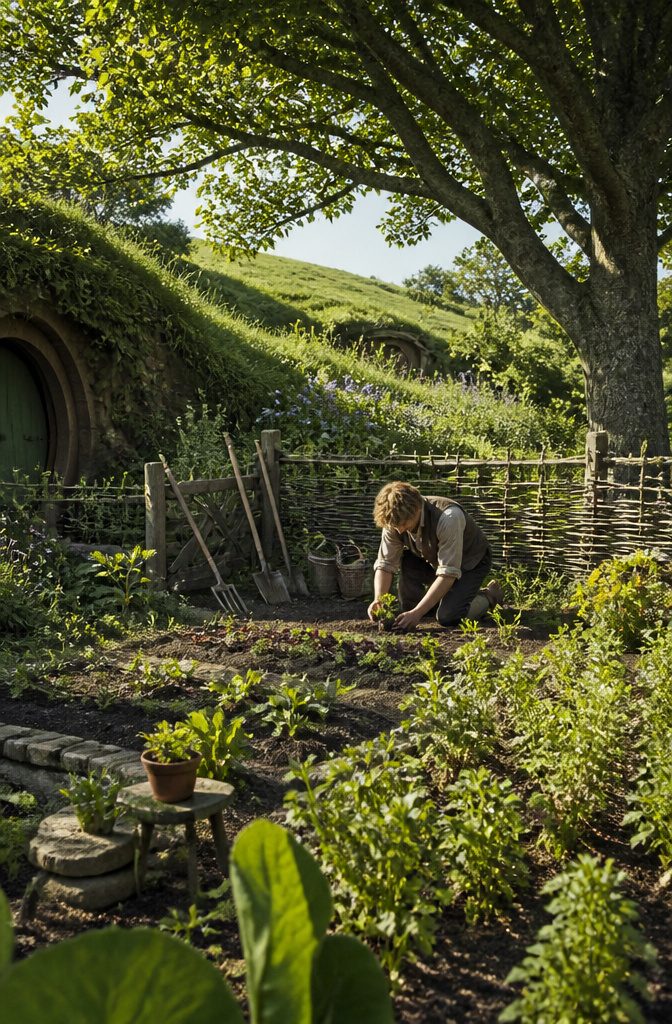
Samwise Gamgee was born in TA 1380, the youngest son of Hamfast Gamgee and Bell Goodchild, with five siblings ahead of him: Hamson, Halfred, Daisy, May, and Marigold.
The Gamgees lived on Bagshot Row, hard by Bag End in Hobbiton, where Sam’s father worked the gardens and earned the nickname the Gaffer.
That proximity shaped everything.
Bilbo Baggins took notice of the curious lad who loved Elves and memorized verses, and over years of tutoring he taught Sam to read, to write, and to look past the Shire’s hedgerows for the wider world.
Sam learned early that loyalty to a person could outrun fear, a lesson he would test on roads far from home.
A gardener’s work is patience: seasons of compost and root and waiting. Sam brought that temperament to every field and swamp of the quest, along with a plain hobbit’s habit of speaking the truth even when it cost him.
By the time Frodo Baggins needed someone to walk with him to Mordor, Sam had already been tending that ground for years.


Rosie Cotton of Bywater
Rosie Cotton came from a farming family with land and a house to their name, which set her apart from Sam even before he left the Shire.
Her father was a master; Sam’s father was a land worker with no prospect of advancement, especially once the Sackville-Bagginses stood to inherit Bag End. That social gap did not stop her from seeing something in him that others missed.
She represented home and stability for Sam long before he marched into the unknown.
When Frodo told the Gaffer that Sam had become "one of the most famous people in all the lands," the old man’s imagination could not hold the idea. Rosie’s eyes shone.
She smiled at Sam. That moment is worth re-reading: it shows who she already was to him, the living reason to return.
Her practical view, later calling his year away "wasted" time they could have spent building a household, was not complaint so much as the groundedness that balanced his larger adventures.

【Cherry Blossom Design】Experience the magic of spring all year round with these solar Christmas lights, inspired by flower - cherry blossoms. The 60 LED bulbs in each 26ft string (19.4ft lighting length, 6.6ft lead length) add a charming touch to your garden, and multiple sets can be connected for an even more enchanting effect;

【Fresh Botanical Allure】: 10 delicate green and white flower garlands softly encase warm white bulbs, casting a serene, garden-fresh glow that evokes dewy mornings in a spring meadow. Perfect for creating a natural, rejuvenating ambiance on patios, weaving through indoor plants, or adding organic charm to wedding arbors and sunroom nooks.

【Enchanting Floral Elegance】:10 delicate white flower garlands encase warm white bulbs, casting a soft, romantic glow reminiscent of moonlit blossoms. Perfect for creating dreamy bohemian ambiance in gardens, wedding arches, or adding whimsical charm to bedroom canopies and porch railings.
What Kept Sam Going

Tolkien called Sam the "chief hero" of the whole story, and the reason sits partly in what Sam carried with him that the others did not.
Before he ever left the Shire in April of 1418, he had already made his understanding with Rosie Cotton.
She was the daughter of a farmer who owned his own house and land; Sam was a gardener’s son with no prospects and no inheritance beyond the hope that the Sackville-Bagginses might prove generous, which everyone knew they would not.
Rosie saw something in him anyway.
That quiet commitment became the ballast of the quest.
Where Frodo had the Ring’s weight and Gollum had his obsession, Sam had memory of Rosie and the life they had planned: a home, children, the serious business of building something ordinary and good.
In Mordor’s ash and darkness, that memory was what let him put one foot in front of the other and, when Frodo failed at the last, to pick him up and carry him.
Tolkien placed special emphasis on Sam’s "rustic love" for Rosie, the simple, grounded devotion that made him the quest’s indispensable keeper.
The bond was never the elevated romance of Arwen and Aragorn. Sam came home feeling "torn in two," half drawn to Frodo’s wider world and half wanting only the life Rosie represented.
She thought he had wasted a year. He married her anyway, and the marriage was a good one, full of children and eventually grandchildren, Sam serving seven terms as Mayor before he followed Frodo across the Sea.
The love that sustained him was not poetry. It was better than that: it was the reason to come home.

For couples who prefer a rustic or country - themed wedding, wooden chair signs are a perfect fit. They can be left with a rough, unfinished edge or distressed to give an aged, vintage appearance, enhancing the overall rustic aesthetic of the event.


🔥①【Material】Made of pure natural wood. High-quality printing on wooden plaques
The Return and the Waiting
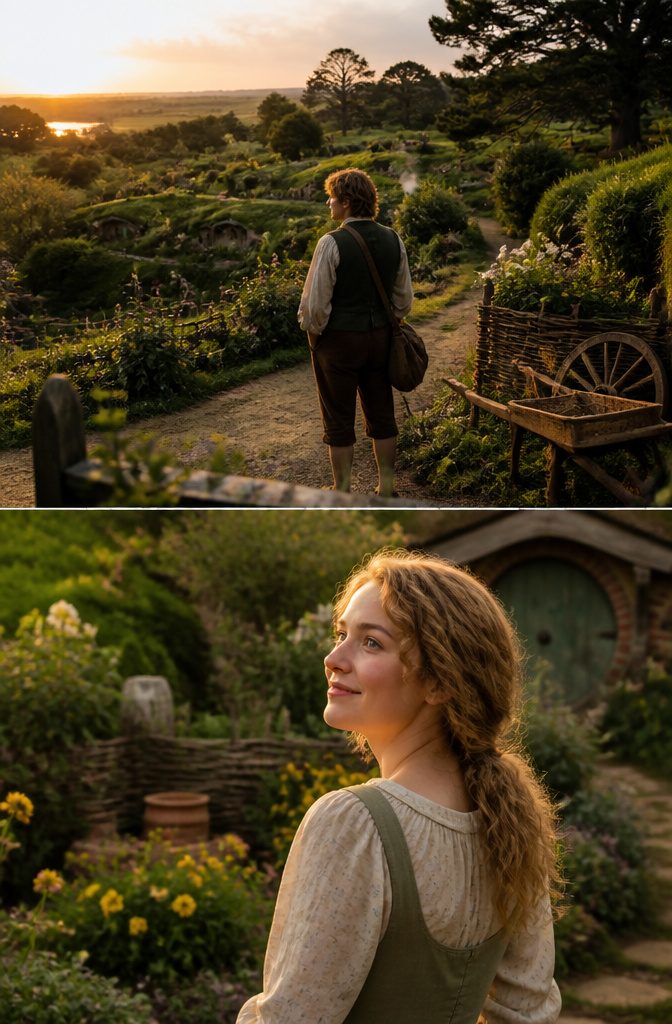
Sam was conscripted in April 3018, Third Age, with an understanding already settled between him and Rosie Cotton.
She was a farmer’s daughter, her father a master with his own house and land, while Sam stood only as the son of a land worker with no prospects of changing station.
The Sackville-Bagginses stood as heirs to Bag End, and their reputation offered little hope of generosity to retainers. Rosie saw something in him anyway.
He left a servant and returned, as Frodo told the skeptical Gaffer in Rosie’s hearing, as "one of the most famous people in all the lands," with songs of his deeds spreading from the Sea to beyond the Great River.
The Gaffer put this out of his mind as beyond his imagining. Rosie’s eyes were shining and she was smiling at him.
Those thirteen months, by Shire Reckoning, cost them something.
Sam later spoke of feeling "torn in two," half longing for the life Frodo represented, and Rosie, in her practical way, considered it a year wasted from the serious business of making a home.
She never quite grasped the nature of his fame, and so never became the romantic soul-mate Arwen was to Aragorn.
What waited for him instead was steadier: a woman who had judged rightly, who had kept faith through a war she could not see, and who intended to get on with living.

Size: The frame measures 8"L x 10"W x 0.4"D and holds a 4" x 6" Photo.

Size details: The outer dimensions of this photo frame are approximately 8X5.7 inches, which can display 4X6 inch photos. It has a unique design and comes with a black iron frame.

FRAME A SPECIAL MOMENT: This keepsake frame is a lovely way to showcase your photos and title them with affection. Beautiful, clean and sweet, the wooden cutout letters give the frame an emotional punch as it emphasizes your precious pictures. They say a picture is worth a thousand words, so this photo sentiment frame goes above and beyond the standard worth
The Wedding of March 22, 1419
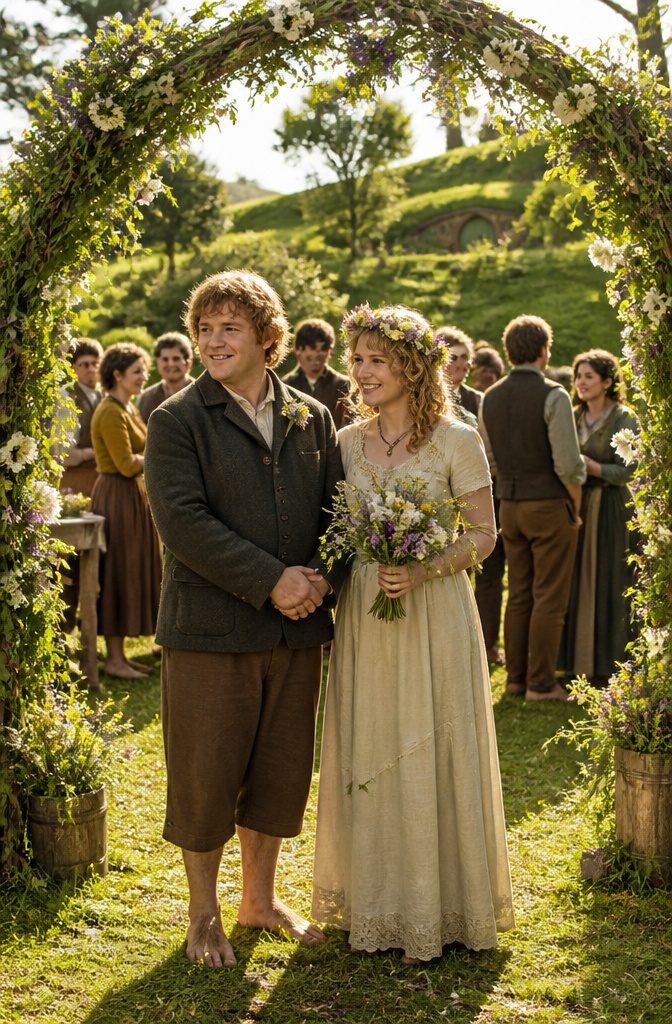
March 22, 1419 sits in the Shire calendar as the day Samwise Gamgee married Rosie Cotton, and the date itself carries weight.
It falls in the spring after the Ring’s destruction, with the war ended and the Shire still healing from Saruman’s men.
The timing matters because Sam does not rush straight from Mount Doom to the altar. He returns, he serves, he rebuilds, and only then does he ask.
Their wedding stands apart from the grand romances Tolkien gives us elsewhere.
Aragorn and Arwen’s union spans ages and bloodlines; Eowyn’s love for Faramir carries the shadow of war and a renounced crown. Sam and Rosie offer something plainer.
She kept his garden alive while he walked into Mordor, and he came back to tend it with her. The marriage is not the reward for heroism but the next thing that needed doing.
Tolkien wrote their bond as the ordinary choice made extraordinary by context. Sam could have sought adventure after the quest, could have lingered in the circles of the wise.
Instead he chose the Gaffer’s house, a family, and the work of growing things. That choice, made in the spring of 1419, is what the story trusts most.

【Size】: 6x4 FT(WxH) / 71 inches x 47 inches. Support customization, like size, color, pattern, text or other changes you need

【Size】: vinyl background 7x5 FT (84 in high and 60 in wide )
Life as the Gardner Family
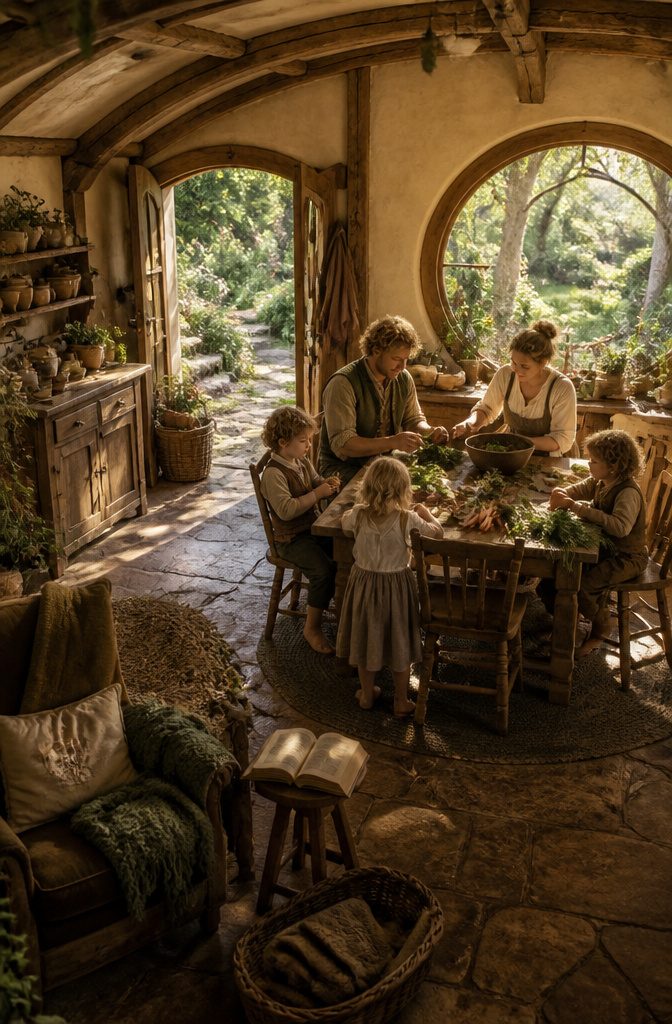
Sam and Rosie’s marriage stretched across decades of ordinary days in the Shire, the kind of life built on tending gardens and raising a large family together.
Their daughter Elanor was the first of many children, and the name Samwise Gardner eventually replaced Gamgee in daily use, marking how fully he stepped into this new identity rooted in soil and home.
The family line grew so large that Sam’s household became its own small community, the work of his hands feeding generations. When Rosie died in the year 61 of the Fourth Age, Sam was 102.
At that age he entrusted the Red Book to Elanor, the chronicle of the great journey now passing to the child who had never needed to make it herself.
The gesture closed one era and opened another: Sam left the Shire not long after, traveling to the Grey Havens and sailing west as a Ring-bearer to reunite with Frodo in the Undying Lands.

【Green & White Florals, Romantic Ambiance】:Green and white floral string lights feature fresh two-tone petals paired with delicate simulated stamens, boasting a strong three-dimensional effect and vivid, lifelike shape. Ten flower shapes gently encase warm white LED lights, with soft light seeping slowly through the petals and stamens to cast hazy, gentle light and shadow. Suitable for garden parties, weddings, bedrooms, porches and other scenes, it adds a bohemian romantic vibe to the space.

Flower Lotus Shaped Design-- realistic and vivid 50 soft plastic crystal double layer petals LED lights. It emits colorful light, bringing you dreamlike beauty, perfect match with Christmas tree and garden fence, fantastic decoration for holiday, garden, patio, yard, wedding, party, tent, gazebo, etc.

Outdoor String Lights: 48 ft long string lights with 15 hanging 11 watt bulbs spaced 3 feet apart. Brightech porch string lights are approved for residential and commercial lighting. Works with Alexa to turn on/off, requires hub sold separately. Connect up to 5 strands end to end. (Please NOTE: Bulbs are dimmable, dimmer sold separately. Made for use with 110v only.)
Why Tolkien Chose This Marriage
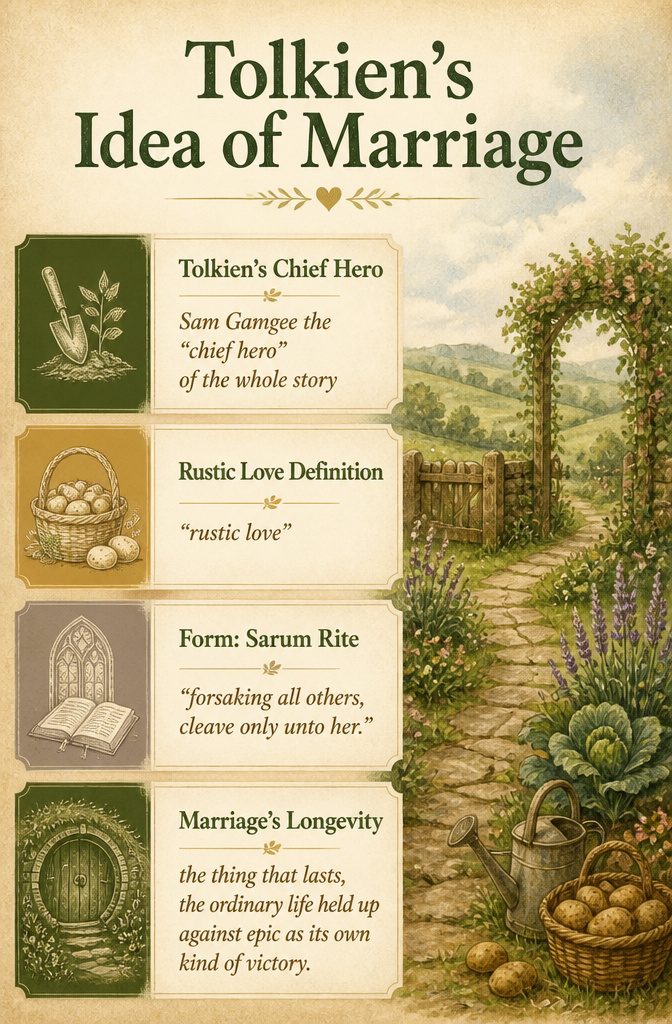
Tolkien called Sam Gamgee the "chief hero" of the whole story, and the phrase he kept returning to was "rustic love." That mattered to him.
In an age when his contemporaries were writing tortured aristocrats and doomed poets, Tolkien put the highest value on a plain-spoken gardener who called his master "Mister Frodo" and measured his life in potatoes planted and children raised.
The marriage itself follows the form Tolkien knew: the Sarum Rite from the 15th century, the ancient English service with its "forsaking all others, cleave only unto her."
He was doubtful about soul mates in general, and told his son so in plain terms. Sam and Rosie were the exception he allowed himself.
What strikes me is the timing. Rosie says she had expected Sam since the spring, and that spring lines up with the destruction of the Ring.
Two people keeping pace across a distance neither could name. Frodo has to tell Sam he is meant to be whole, to choose one life and not be torn in two.
Sam does choose, and still, after thirteen children and decades of mayorship, he crosses the sea only when his work is finished.
This is not the romance of Aragorn and Arwen, which burns bright and ends. Sam and Rosie’s partnership is the thing that lasts, the ordinary life held up against epic as its own kind of victory.

Our wedding welcome sign is the perfect way to greet your guests as they arrive. This beautifully designed wedding decor will set the tone for your event and let everyone know they are in the right place. Whether you're looking for a rustic, elegant, or modern welcome sign, we have something to suit every taste. Our wedding signs are made of high-quality materials and are built to last. So please, come on in and enjoy the celebration!

The message “Better Together” is a powerful and heart - warming concept that resonates with people on an emotional level. It can be used in various settings such as weddings, family reunions, or community events. A wooden sign on chairs reinforces the idea of unity, connection, and shared experiences, making the event more memorable and meaningful for attendees.

Great memorial for honoring the Grandma of the Groom, In loving memory of the ones who shaped us and guided us through life’s journey
What Fans See in Their Bond
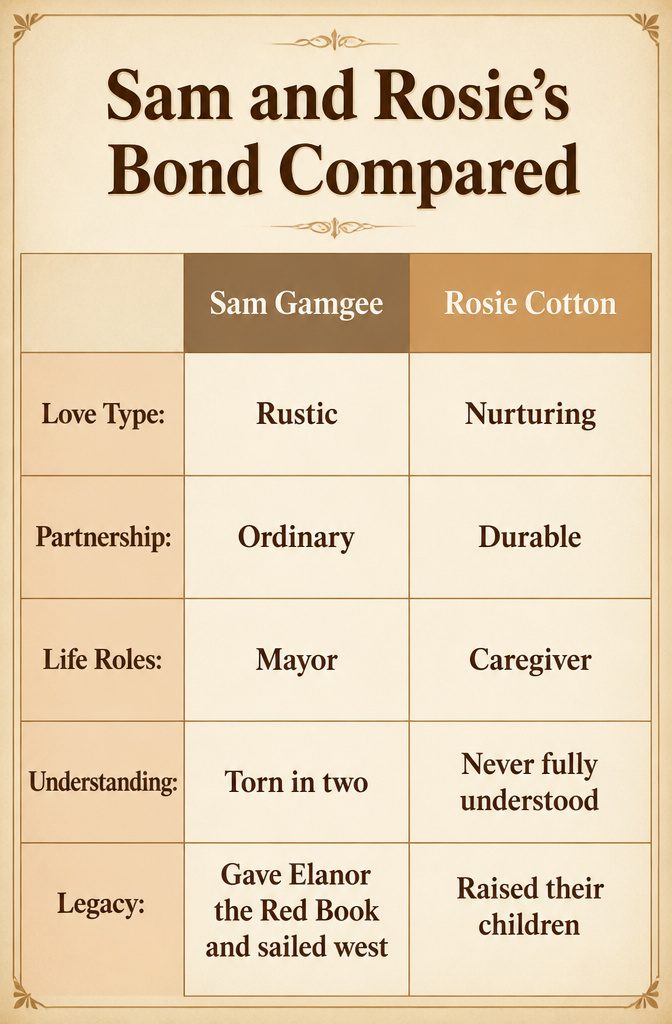
Tolkien called Sam the "chief hero" of the whole story, and the phrase he used for what Sam felt for Rosie was "rustic love." That wording has stuck with readers for decades.
It sounds small, almost dismissive, until you sit with it. Rustic love is not the sweeping romance of Aragorn and Arwen, with elven lineage and epic sacrifice.
It is the love of someone who comes home dirty from the garden and wants the same chair, the same face across the table, the same routine tomorrow.
Some fans have read Sam and Rosie as a comfort, not a passion. Rosie never fully understood what Sam had done or seen, and Sam himself admitted to feeling "torn in two," half pulled toward the life Frodo represented.
Their marriage worked because neither of them seemed to need it to be something grander.
She raised their children. He became Mayor.
When Rosie died, Sam gave their daughter Elanor the Red Book and sailed west. The partnership held for a lifetime without requiring soul-deep communion.
For modern readers planning marriages of their own, that reading lands close to home: the choice to build something ordinary and durable, even when part of you still imagines a different life.

Romantic Handcrafted Rose Design - Featuring a full border of meticulously sculpted roses, this photo frame brings an elegant vintage charm to any space. Each petal and bloom is crafted with fine detailing, making it a perfect piece for romantic home decor, weddings, or special memories. Adds a rich and sophisticated touch to your favorite photos, offering a timeless elegance that pairs beautifully with a variety of decor styles

HANDCRAFTED CHARM: Each 6"x6" frame is handmade with linen fabric, adding a unique, rustic touch to your home decor

HORIZONTAL FRAME: This horizontal metal picture frame is adorned with the “If You Live To Be a Hundred” quote on the linen display border
Frequently Asked Questions
What was the nature of Samwise and Rosie Cotton’s relationship?
Sam and Rosie shared what Tolkien called "rustic love," a plain, grounded devotion rather than an epic romance.
Rosie never fully understood the fame Sam earned on his quest, and Sam admitted to feeling "torn in two" between her ordinary life and Frodo’s wider world.
Their marriage worked because both accepted it as something durable and practical, not grand or soul-deep.
When did Samwise Gamgee marry Rosie Cotton?
Sam married Rosie on March 22, 1419, in Shire Reckoning.
The date falls in the spring after the Ring’s destruction, with the Shire still healing from Saruman’s occupation. Sam did not rush to the altar; he returned, served, rebuilt, and only then asked her to marry him.
How many children did Sam and Rosie have?
Sam and Rosie had thirteen children, with Elanor as the first. The family line grew so large that Sam’s household became its own small community, and the name Gardner eventually replaced Gamgee in daily use.
Did Sam marry Rosie in the books?
Yes, Sam married Rosie Cotton in the books. Their wedding took place on March 22, 1419, after Sam returned from destroying the Ring with Frodo.
Tolkien wrote their bond as the ordinary choice made extraordinary by context, with Sam choosing garden and family over lingering in the circles of the wise.
Who was Sam’s true love in LOTR?
Rosie Cotton was Sam’s true love, though Tolkien deliberately framed their bond as "rustic love" rather than elevated romance.
Rosie represented home and stability for Sam before he ever left the Shire, and their quiet commitment became the ballast that carried him through Mordor. She was the living reason he had to return.
Was Frodo in love with Sam?
The relationship between Frodo and Sam was a bond of love and trust, but it was class-oriented and master-servant in structure, not romantic. Sam showed deference to Frodo, calling him "Mister Frodo," while a strong loyalty grew between them.
Sam himself felt "torn in two" after the quest, half drawn to Frodo’s wider world and half wanting only the life Rosie represented; Frodo ultimately told Sam he was meant to be whole and choose one life.