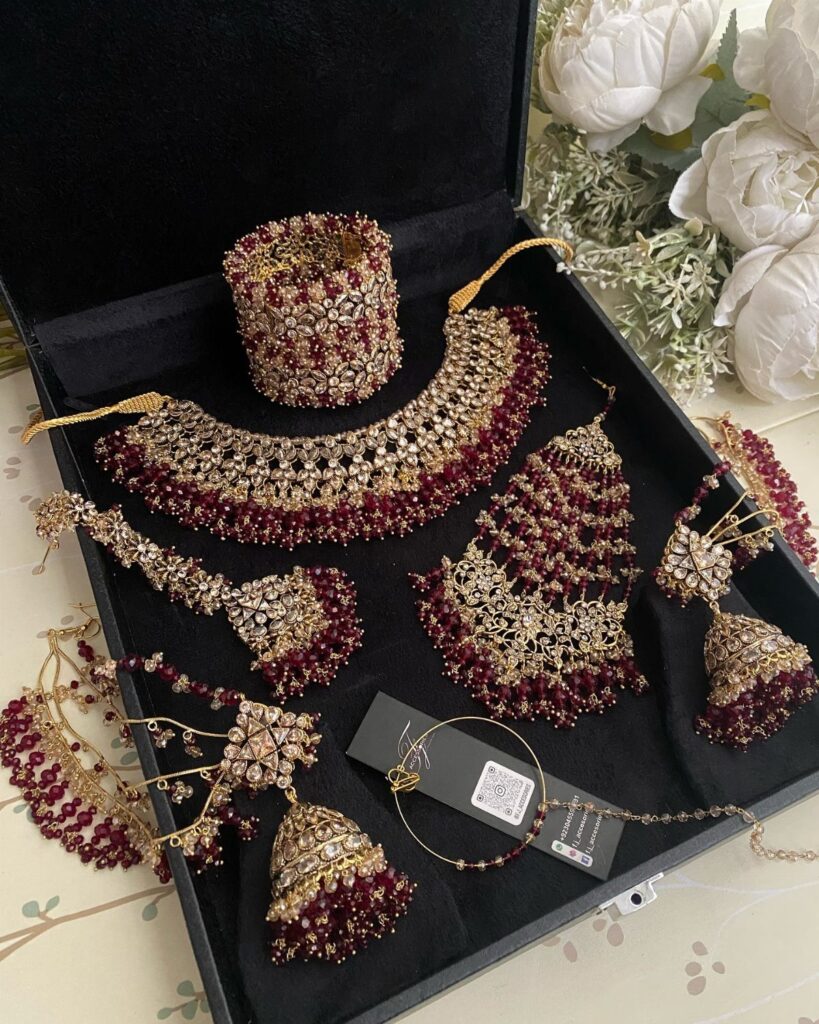
The full set runs from a single statement ring to necklace, earrings, maang tikka, jhoomar, and nath, with the deciding factor being whether the bride is dressing for the full ceremony or paring back for a smaller walima.
A single bridal look can carry serious weight: a 50-gram gold necklace with filigree work is common, and twenty to forty bangles on each wrist is ordinary.
1. Pakistani Bridal Necklaces
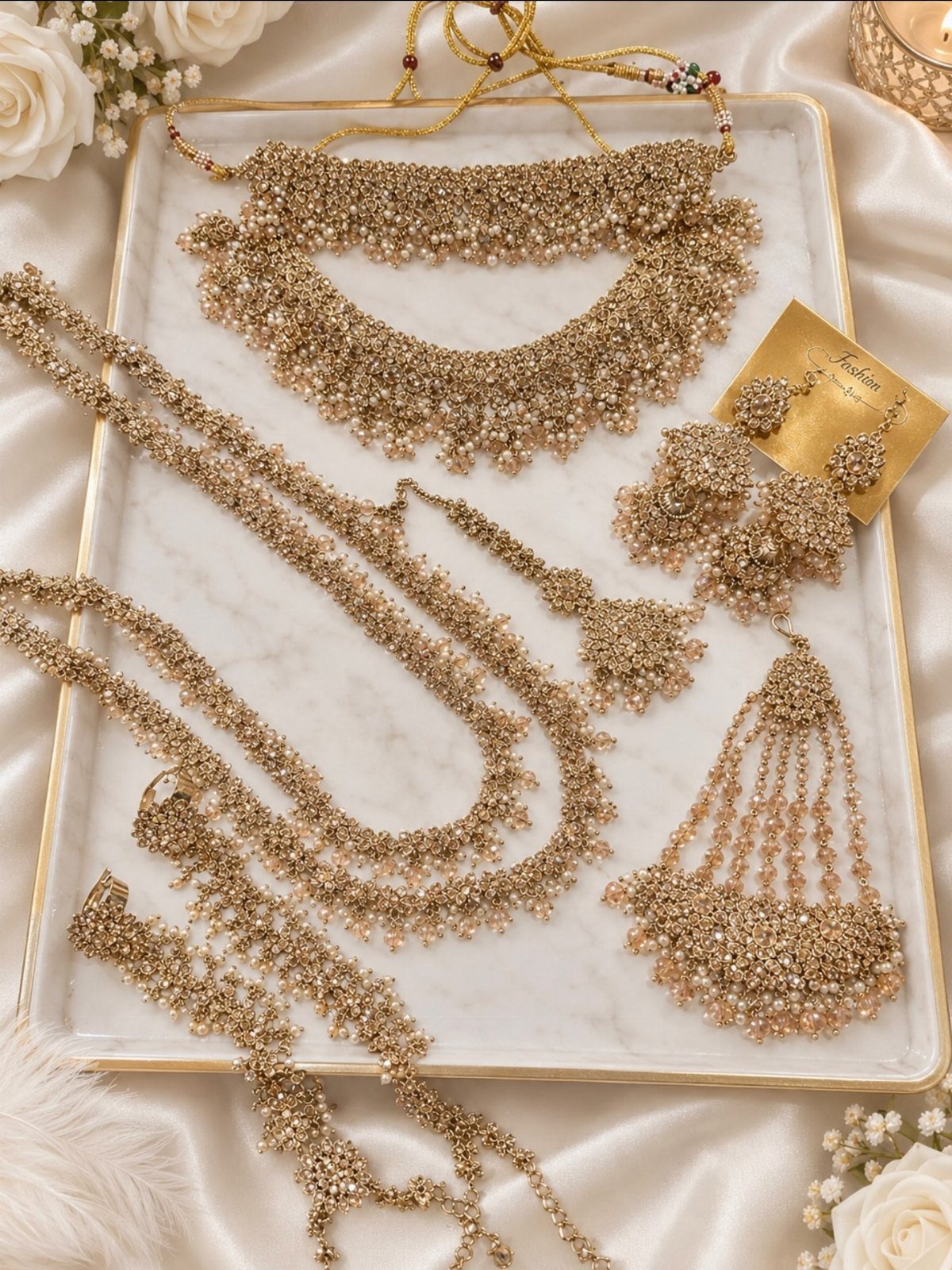
A Pakistani bridal necklace sits at the center of the whole look, usually built in 2 layers: a choker that hugs the collarbone and a longer piece that falls to the chest.
The weight is real; a 50-gram gold set with filigree work and teardrop stones is common, and the filigree is what gives it that lace-like density without making it unwearable.
I would look for sets that include both necklaces together rather than mixing singles.
The stones need to speak to the outfit: emeralds against deep red, rubies against maroon, sapphires against navy. Pearls soften everything and catch the hall light during the rukhsati.
Budget trade-off: a full set with both necklaces, earrings, and maang tikka costs more upfront than building piece by piece, but the matching work is already done.

Mughal Rani Haar Design : Features a multi strand green bead necklace paired with an ornate filigree pendant inspired by traditional Mughal artistry. The detailed centerpiece and coordinated chandelier jhumka earrings create a bold statement for bridal and festive wear.

High Quality Material : This Women's Jewelry Set is made of eco-friendly brass & Clear Cubic Zirconia. High Polished. Hypoallergenic and Shiny Forever. Our Jewellery are suitable for almost all Of Sensitive Ears.
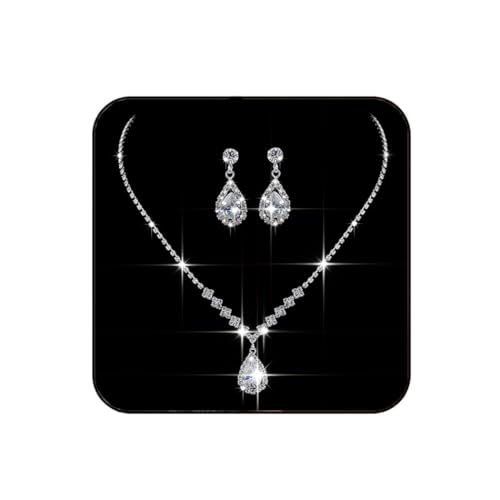
Wedding jewelry is made of crystal rhinestone and alloy.
2. Earrings
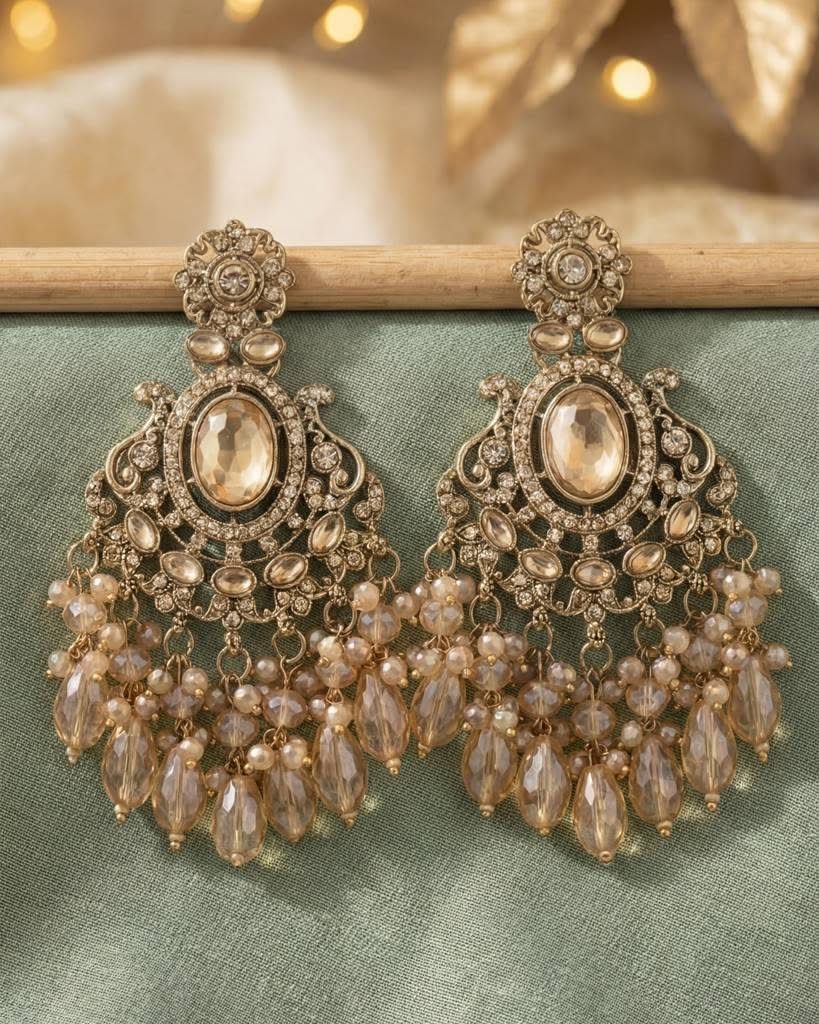
Pakistani bridal earrings run large, by design. Chandelier drops with clustered beads and colored stones frame the face in photographs and move when the bride turns her head.
Champagne stones, rhinestone layers, and bead clusters at the bottom give these earrings their weight and movement. That weight needs a secure hook or a thread loop through the ear, not a simple post.
Matching matters less than complementing.
The earrings should pick up one color from the necklace and one from the outfit, not mirror both. If the necklace is filigree-heavy, I like earrings with more open space so the face does not disappear into metal.
Ask whether the pair can be fitted with a counterweight or a second thread loop behind the ear, especially if you will be wearing them from the ceremony through the reception.

Wedding Bridal Party Rhinestone Marquise Cluster Chandelier Dangle Statement Earrings 18K Gold-Plated Color
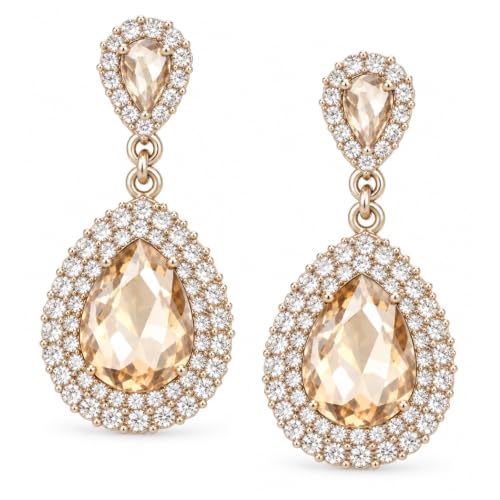
SIGNATURE LOOK — Clustered champagne-tone rhinestones arranged in a softly tapered teardrop gives this champagne teardrop earrings its distinctive character. The shape, color, and surface details work together as a clear focal point, offering enough visual presence for a dressed-up outfit while remaining approachable for repeat styling throughout the season

Material: Adorned with selected Austrian Crystal, crafted with eco-friendly Zinc alloy, Lead-Free and Nickel-Free, this special design is born to match the clothes and your unique beauty.
3. Bracelets and Bangles
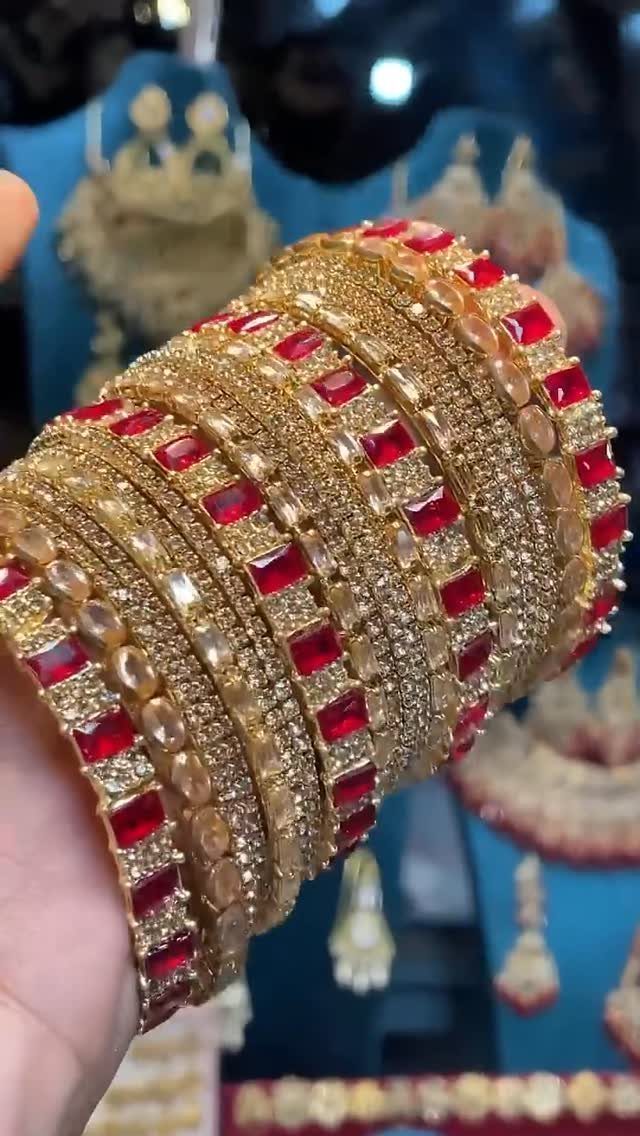
Bangles arrive in stacks, not singles. Twenty to forty on each wrist is ordinary for a Pakistani bride, and the sound they make is part of the entrance.
Loading a hand with gold bangles set with clear and rectangular red stones builds impact through repetition rather than relying on any single standout piece.
Mixing materials keeps the stack from feeling flat. Layering resin bangles in maroon with gold-toned metal set with pearls and crystal-studded pieces creates a stacked look that photographs well against mehndi.
I would build the stack the day before, working from wide at the wrist to narrower toward the elbow, and secure the top layer with a safety pin through the dupatta if needed.
The practical limit: what the bride can lift her arms in. Test the full stack before the mehndi night.

Size: Sapphire Necklace Length: 42cm(16.5") Width:1.3cm(0.5") ; Earrings Size: 3.9cm(1.5")by1cm(0.4"); Total Weight: 55.8 g

♥Material: Made of Gorgeous & Sparking Cubic Zirconia, crafted with eco-friendly brass, this silver-tone Teardrop V-necklace sets shines with grace and beauty. Wearing it will make you more eye-catching in important occasions.

Leaves have provided our designers a great deal to emulate in the way of shapes, textures, and colors of our jewelry. This wedding jewelry set can be worn with classy casual or formal attire. Wearing a strapless dinner dress, formal gown or casual wear, matching this gorgeous necklace earrings bracelet set, it will make you more eye-catching in wedding ceremony, reception, party, dance and other gorgeous events.
4. Rings
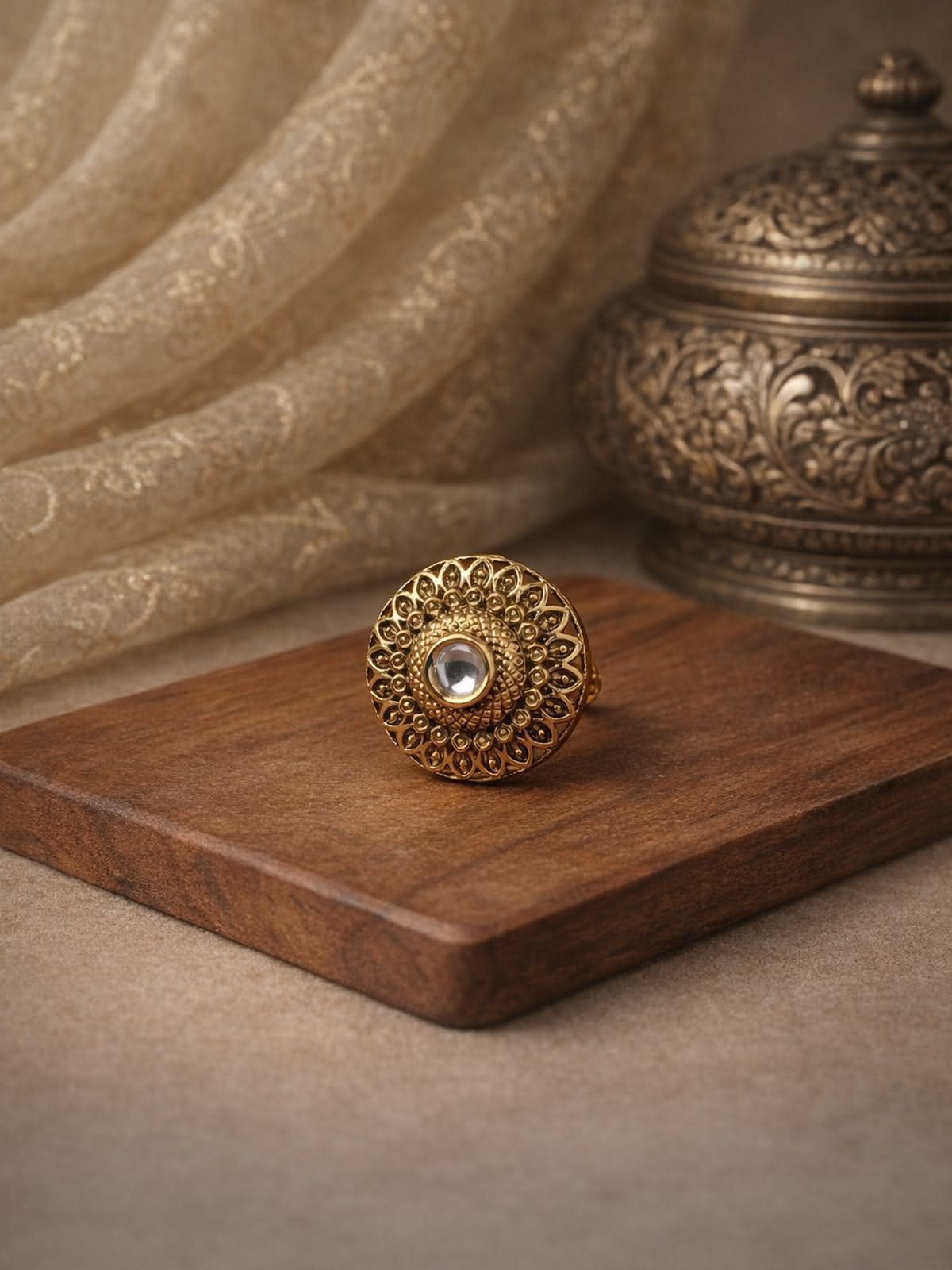
A bridal ring in this tradition is not subtle. Filigree work spreads wide across the finger, holding a central stone with smaller detail around it for a piece that reads from a distance.
Kundan-style construction, with stones set in gold-toned metal and backed with foil to catch light, is what gives that flat, glowing surface.
Rings are often sold as part of the full set, easy to overlook when the necklace and earrings dominate the budget.
I would check whether the set ring is sized or adjustable; a fixed size needs ordering early, and resizing filigree risks cracking the setting.
If the full set is out of reach, a single statement ring worn on the right hand photographs almost as well and costs far less than the necklace alone.

SPECIFICATION : Each package contains 1 piece of chand maangtikka.Made from durable alloy metal, featuring a luxurious Kundan appearance, adorned with sparkling rhinestones and faux pearls. Designed with an adjustable length to ensure a perfect fit, accommodating various chain lengths comfortably.

SPECIFICATION: Each package contains 1 piece of chand mang tikka.Made from durable alloy metal, featuring a luxurious Kundan appearance, adorned with sparkling rhinestones and faux pearls. Designed with an adjustable length to ensure a perfect fit, accommodating various chain lengths comfortably. Size: 6.5 Inches Length, 1-1/2 Inches Wide. Color: Ruby

SPECIFICATION : Each package contains 1 piece of Mathapatti/Sheesh Patti.Made from durable alloy metal, featuring a luxurious Kundan appearance, adorned with sparkling rhinestones and faux pearls. Designed with an adjustable length to ensure a perfect fit, accommodating various chain lengths comfortably.
5. Maang Tikka
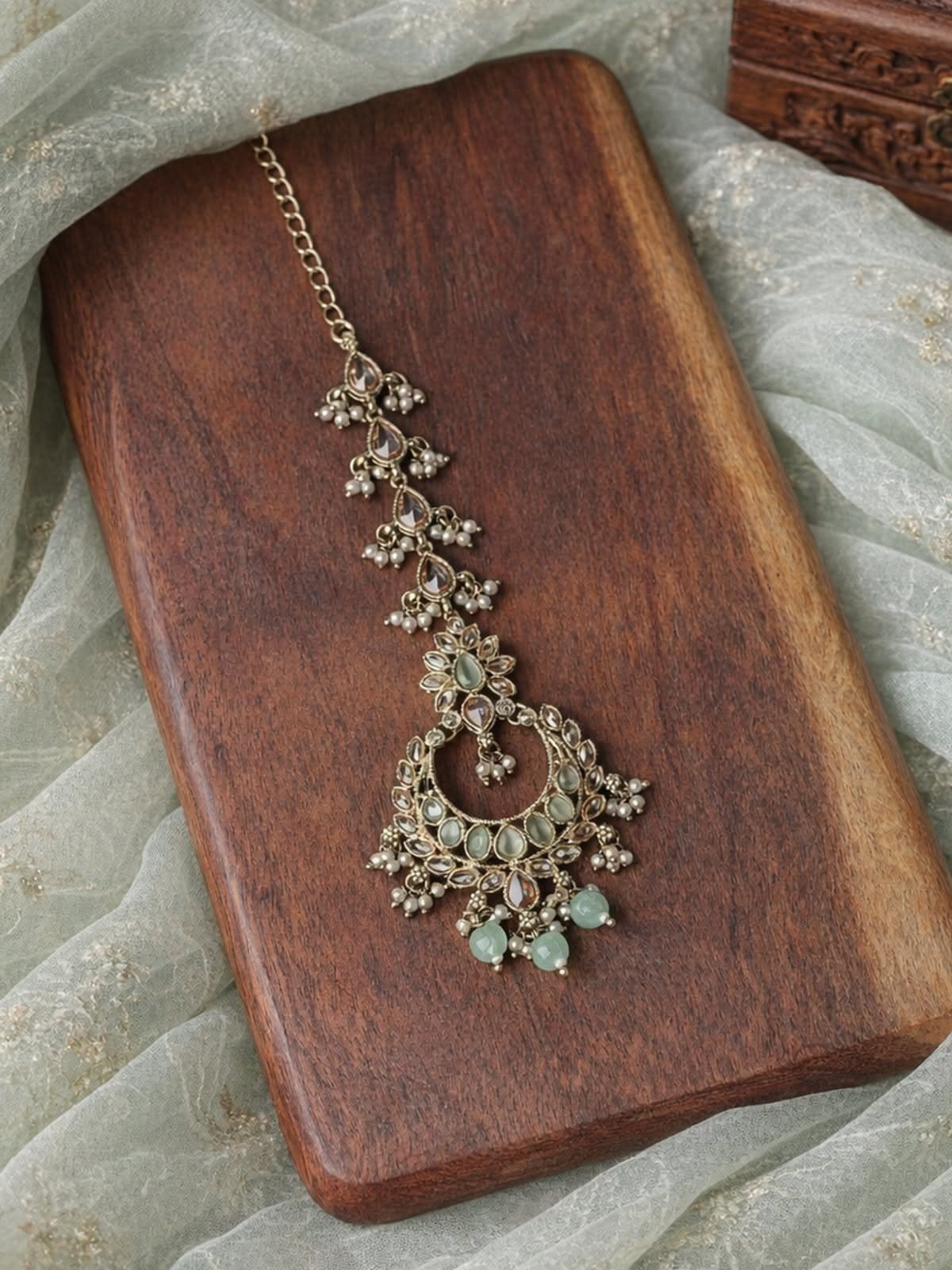
The maang tikka hangs from the hairline to the forehead, a single pendant on a chain that splits the bride’s part.
Antique gold-toned metal paired with pearls and green stones sits against pale fabric in a way that draws the eye straight to the forehead.
The color match to the outfit is deliberate; this piece sits closest to the face and draws the eye first.
Securing it takes more than the chain. A hook or pin at the back of the head keeps the pendant from sliding, and the chain needs tension so the piece does not bounce with every step.
I have seen brides use a second, hidden chain under the bun for stability.
For variation, some sets include a matha patti, a band across the forehead with side chains. That needs a higher bun and more confidence; the maang tikka alone is the safer choice for a first wearing.

Indian Ladies' Bangle Set: you will receive 150 gold, shimmering ladies' bangles; Whether you're hosting a Mehndi ceremony, wedding, Puja ceremony, or Diwali celebration, these bangles are the perfect Indian celebratory favor, ensuring every guest takes home a beautiful and unforgettable souvenir


Indian Women's Bangle Set: our 126-piece Ceremony Return Gift Bangle Set contains 6 sets (21 bangles per set) and is the ideal choice for Indian return gifts; This multi-colored rhinestone bangle set is nice as a Mehndi ceremony return gift, Indian wedding gift, sacrificial ceremony return gift, and Diwali return gift, ensuring every guest takes home a gorgeous and unforgettable present
6. Jewelry to Complement Bridal Outfit
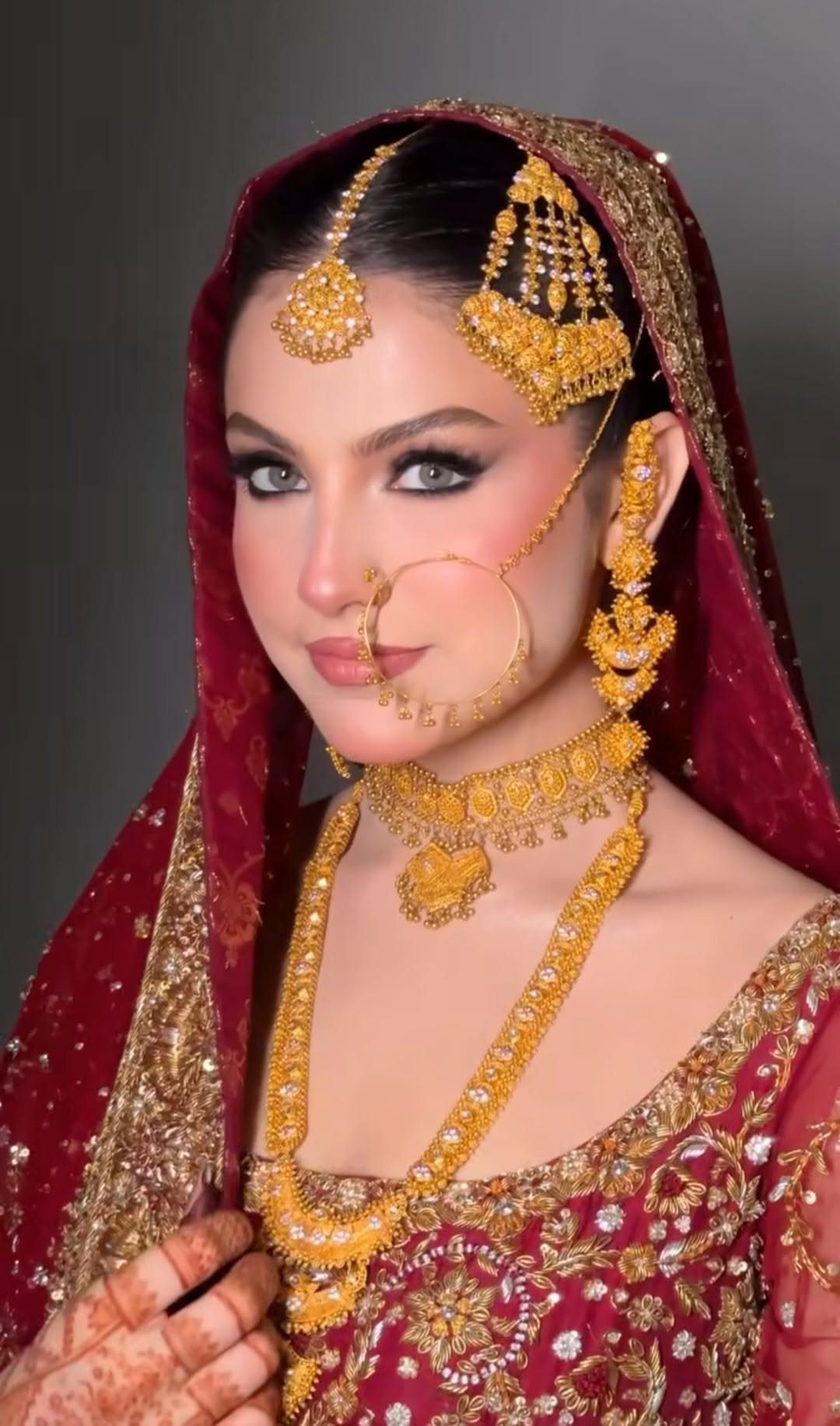
A full bridal look pairs the maang tikka with a jhoomar at the temple, a nath at the nose, and layered necklaces over maroon and gold embroidery.
The jewelry does not fight the dress because every metal tone and every stone color was chosen against that specific fabric.
That coordination is the work, not the buying. I would bring a fabric swatch or a clear phone photo of the outfit to the jeweler, and test pieces in daylight, not shop light.
Gold-toned kundan reads warm; silver-toned or white-metal reads cool; mixing the 2 unless the outfit itself mixes them looks accidental.
The trap is overloading. For the nikah or a smaller walima, I would drop the jhoomar and the second necklace layer, keep the maang tikka and one necklace, and let the outfit carry more of the weight.

Pearl rhinestone necklace with earrings set in unique design and excellent workmanship, made of pearl and alloy.

Diamond necklace with earrings set in unique design and excellent workmanship, made of sparkly crystals and alloy.

Material and Craft:Adorned with selected Austrian Crystal, crafted with eco friendly Zinc alloy, Lead Free and Nickel Free, this special design is born to match the clothes and your unique beauty.
7. Jhumar or Passa Side Headpiece
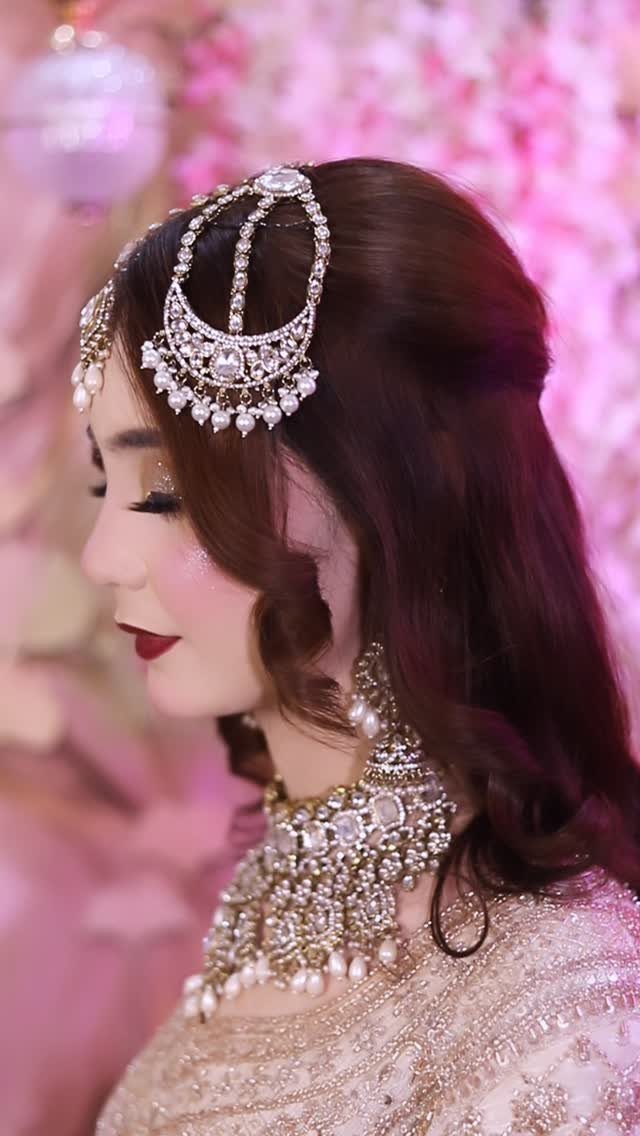
The passa pins at the temple, a fan of gold-toned metal and pearls spreading from a single point against the hair.
Unlike the maang tikka, which draws the eye to the center of the face, the jhumar pulls attention to the side profile in photographs and during the rukhsati walk.
I would match the passa to the maang tikka in metal tone and stone color, but let it be smaller; the 2 pieces compete if both are equally heavy.
Most sets that include a jhumar sell it with the maang tikka as a matched pair, which saves the trouble of mixing singles.
Securing it takes practice. The pin needs to slide through the dupatta or a braid, and a second, smaller pin crossing the first keeps it from rotating.
Test this before the morning of the wedding; temple placement that looks right in a mirror can sit too high or drift toward the ear.
For a smaller walima or a reception where the dupatta comes off, the jhumar is the first piece I would leave behind. It needs the full bridal context to read correctly.
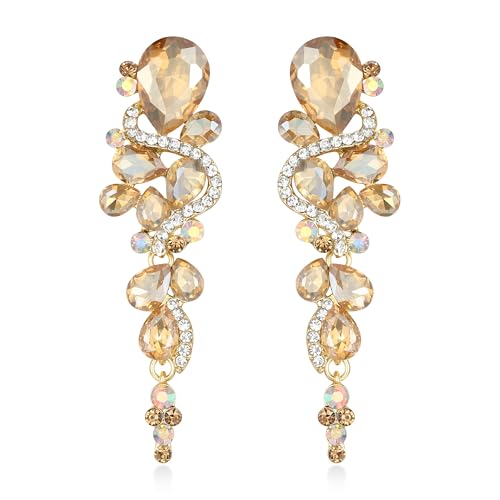
Material and Craft: Adorned with selected Austrian Crystal, crafted with eco friendly Zinc alloy, Lead Free and Nickel Free, this special design is born to match the clothes and your unique beauty.

Product Name: NLCAC long rose gold chandelier earring.
8. Bridal Nath Nose Ring
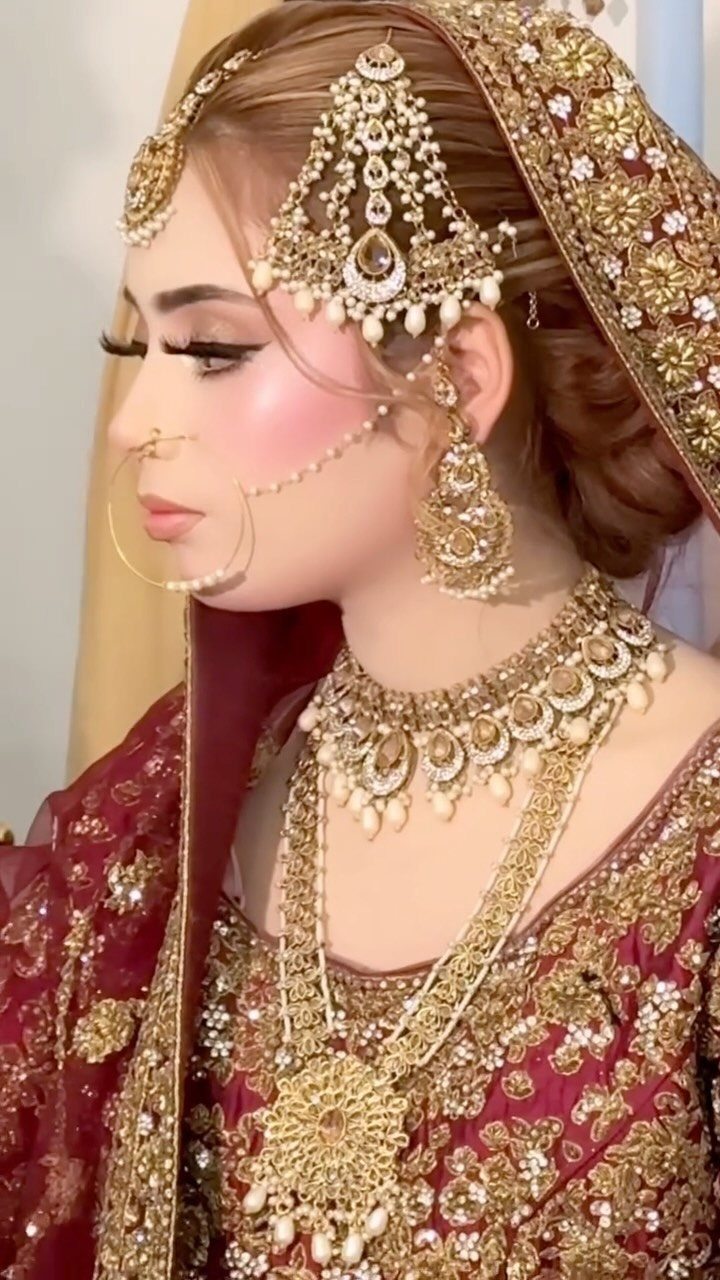
The nath is a hoop, not a stud, and the chain that runs from it to the hairline is what makes it read as bridal rather than everyday.
Antique gold-toned metal with a single pearl or small stone at the center is the classic version; the chain loops over the cheek and fastens with a tiny hook near the ear or slides into the bun.
Sizing matters more than with other pieces. A nath that is too small pinches the nostril and shows in every close-up; too large, and it slides or needs constant adjustment.
The wire should be thick enough to hold its shape through hours of talking and eating, which means testing it in place for a good stretch before you commit.
Some brides skip the chain and wear the hoop alone for the reception.
That reads as modern, but the full piece with chain is what signals the wedding day itself. I would keep the chain for the ceremony and judge the comfort of the whole piece before deciding on the reception.
The hole closes fast if this is a one-day wear. Clip-on versions exist, though they sit heavier and need checking between events.

Material: Under different lights conditions, due to the refraction of light, bracelet may show slight color differences.Adorned with selected Crystal, crafted with eco-friendly Zinc alloy, Lead-Free and Nickel-Free, this special design is born to match the clothes and your unique beauty.

Dimension: Necklace Length: 21.5 cm(extender-3 cm ) x Width: 4.2 cm; Earring Length: 3.7 cm x Width: 1.5 cm; Weight: 29 grams
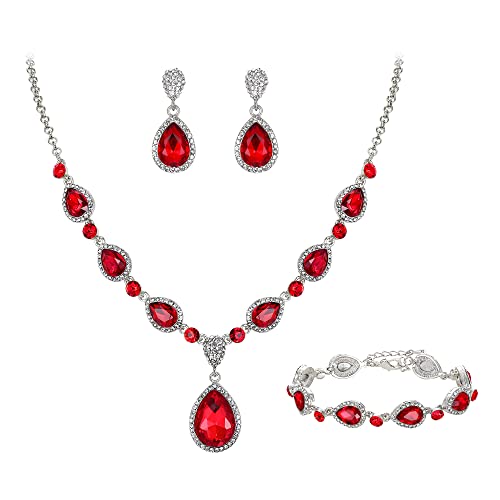
Material This Women's Wedding Jewelry set is adorned with a petite teardrop, Round Cut Rhinestone Crystal; crafted with Alloy, High Polished. Lead-Free & Nickel-Free, Hypoallergenic, this fabulous design is suitable to match formal attire or Wedding dress and show your unique beauty
Jewelry Materials
Most Pakistani bridal sets use gold-toned metal rather than solid gold, which keeps the weight manageable without losing the warmth that reads in photographs.
The stones themselves are where the budget shows. Glass and colored crystal fill most sets, with pearls added as droplets at the edges or clusters in the center.
Real emeralds, rubies, or sapphires appear only in the highest pieces, and the difference in price is steep enough that most brides mix: real stones in the necklace where the camera lingers, quality simulants in the bangles where movement matters more than close inspection.
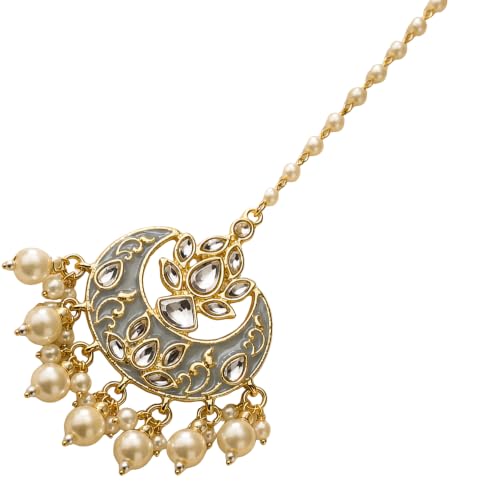
SPECIFICATION : Each package contains 1 piece of chand maangtikka.Made from durable alloy metal, featuring a luxurious Kundan appearance, adorned with sparkling rhinestones and faux pearls. Designed with an adjustable length to ensure a perfect fit, accommodating various chain lengths comfortably.

Silver indian head jewelry for women: This tikka jewelry is crafted from zinc alloy and sparkling glass rhinestones, delivering a brilliant silver shine that instantly elevates any look. The floral centerpiece is eye-catching yet refined, making it a versatile accent for both traditional and modern outfits. Designed for lasting wear with a polished finish.

SPECIFICATION : Each package contains 1 piece of Mathapatti/Sheesh Patti.Made from durable alloy metal, featuring a luxurious Kundan appearance, adorned with sparkling rhinestones and faux pearls. Designed with an adjustable length to ensure a perfect fit, accommodating various chain lengths comfortably. Color: Red
Popular Designs
Floral patterns dominate the metalwork, built from repeated small petals and leaves rather than single large blooms.
That repetition lets the eye read the piece as texture from a distance and rewards closer looking only when someone is near enough to see the individual shapes.
Filigree shows up in every tier of the market, but the density varies. Budget pieces stamp the pattern from sheet metal; better sets have wire filigree, each loop soldered by hand, which gives the lace-like openness that light passes through.
The hand-wired pieces weigh less for their size because so much of the volume is air.
Multi-layered construction appears in necklaces and maang tikka alike: a choker base with one or two longer strands, or a forehead pendant with side chains that frame the face.
The layers move independently, which means they catch light at different angles and keep catching it as the bride moves.

Luxurious Design: A set of 2 gold bangle bracelets for women adorned with sparkling,8.0 inch (65mm) size fits most people's wrists.These gold bangles are perfect for layering or wearing solo, adding a touch of luxury to every outfit you own.

Gold bangle bracelet set: Package includes 12 pieces of beautiful textured bracelets, perfect for women who love Indian and bohemian styles.
Traditional Significance
Jewelry in a Pakistani wedding does more than decorate. The quantity and quality of pieces a bride wears signal family standing, and the full set, necklace to nose ring, marks her transition from unmarried daughter to wife.
Leaving pieces off is read; a bride in only earrings and a necklace at her own nikah would look unfinished.
Specific pieces carry specific weight. The jhoomar at the temple appears only in full bridal dress, not in everyday wear or even at other celebrations.
Gold-toned metal carries the association even when the metal itself is not gold. The color is what reads, which is why silver-toned pieces remain rare unless the outfit itself demands them.
Styling Advice
Start with the outfit, not the jewelry. Mixing the 2 only works when the outfit itself mixes them.
Wear the necklace and earrings together for an hour, the bangles through a normal range of motion, the maang tikka while walking. Weight that seemed fine in the shop drags as the hours go on.
The camera sees differently than the mirror does.
What reads as balanced in reflection can photograph as heavy on one side, especially with asymmetric pieces like the jhoomar. Take a few test shots from the angles the wedding photographer will use.
For smaller events, subtract rather than substitute. Overloading reads as trying too hard; underloading reads as intentional.